

White Sky
A dying man, a fleet of planes, and the world's most dangerous proof of concept.

👋 Hello to 3,413 climate buddies 🌳
Delphi Zero explores the interplay of climate, energy, and security 🌳🔋🛡️
📧 If you are opening this essay in your email inbox, I recommend clicking on the title of this piece to enjoy the full-length version in the browser.
Hey friend,
Normally, I don’t send newsletters on Saturdays. But the great thing about having your own newsletter is that you get to make the rules. So here we are.
Also, sometimes, I like to write climate fiction. The last time I published a cli-fi story was - *checks notes* - back in October 2023.
Why so long? Because I got obsessed with a a very specific story. A story about the risks and opportunities that new technologies carry.
Ever since reading my friend Ben’s article about atmospheric sulfur injection to dim the sun, I’ve been trying to wrap my head around how to tell this story. Many drafts later, I wasn’t happy with it and shelved it. Two years later, (I think) I finally cracked it.
This is the story that deserved to be told for a long time.
I hope you enjoy reading it 🙏
White Sky
By Art Lapinsch | Delphi Zero | 2029

The first thing you notice in Chennai is the light.
Not the sun itself. You can’t really see the sun anymore, not the way you used to. What you notice is the quality of the light: a diffuse, hazy glow that makes everything look like a photograph taken through a window smeared with Vaseline. Locals have started calling it vellai vanam. The white sky. Street vendors sell polarized sunglasses with a wink: “For the new India.” Children who were born after the deployment don’t know the sky was ever different.

I arrived in Chennai eighteen months after Rajesh Patel’s fleet turned the stratosphere into a mirror. I came to write about the man who did it. I left understanding that the man doesn’t matter. What matters is the door he opened. And the fact that it doesn’t close.
I. The Richest Man You’ve Never Heard Of
To understand what Rajesh Patel did, you first have to understand where he came from.
Not Mumbai. Although that’s where RP Industries was headquartered by the time he became one of the forty wealthiest people on the Indian subcontinent. Patel grew up in Bhuj, a city in Gujarat’s Kutch district that sits on the edge of salt flats so vast they can be seen from space. Kutch has always been a very particular plot of land. Hot, dry, prone to earthquakes. But when Patel was a boy, in the late 1980s, there was still a season when the rains came and the white earth turned green for a few weeks.
That season doesn’t exist anymore.
By the time I began reporting this story, I couldn’t find a single resident of Kutch under the age of thirty who remembered a reliable monsoon. The rains still come, but they come wrong. Too much water in too little time, then nothing for months. The old farmers call it paagal mausam. Crazy weather.
Patel left Kutch at seventeen. He studied engineering in Ahmedabad, then built a logistics company that grew into a conglomerate spanning shipping, defense contracting, and industrial chemicals. RP Industries was not a household name outside of India, but within the country’s defense establishment, Patel was a man who could get things done without attracting attention. His company held long-standing contracts with the Indian Ministry of Defence for high-altitude aircraft. Modified jets that could operate at the edge of the stratosphere for surveillance, reconnaissance, and cargo delivery to remote Himalayan border posts. This work gave Patel access to military airfields, classified procurement channels, and the kind of relationships that don’t show up in annual reports. It also gave him a fleet of aircraft that could fly higher than almost anything else in the Indian inventory.
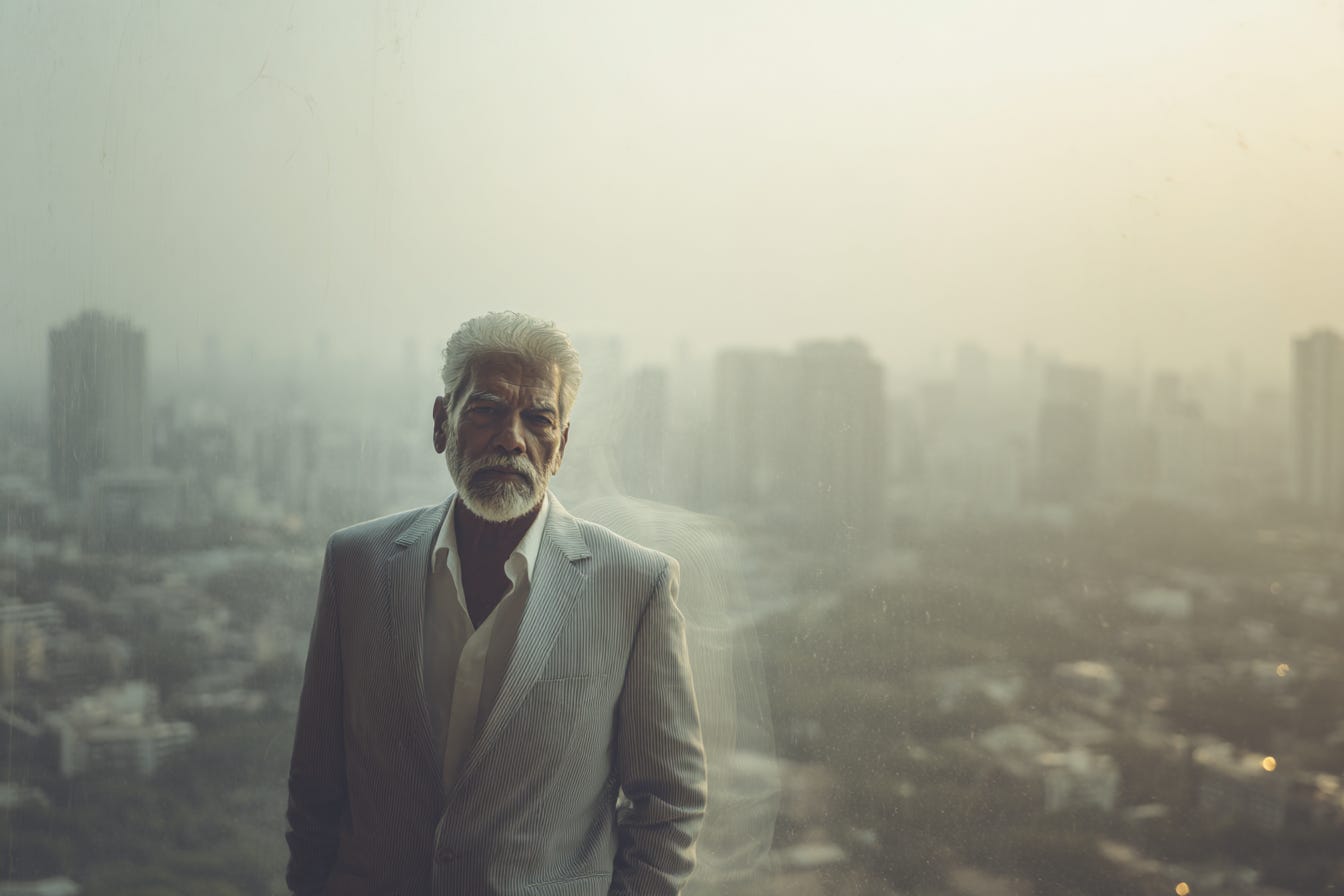
I spoke to eleven people who knew Patel personally. Every single one of them described some version of the same scene: Patel pointing at an air-conditioning unit and asking whoever was in the room whether they remembered sleeping through the heat as children. It was a tic, almost a compulsion. The cool air in his offices (which were kept at a frigid nineteen degrees Celsius) seemed to remind him of something he couldn’t stop thinking about.
“He talked about it the way some men talk about a woman they lost,” his longtime driver told me. “The coolness. Not the machine that makes it. The feeling of being cool.”
In March of last year, Patel was diagnosed with pancreatic cancer. The prognosis was five weeks. He lasted seven.
In between the diagnosis and his death, he launched what atmospheric scientists would later call the first confirmed act of unilateral stratospheric intervention. The aircraft were already there. RP Industries’ high-altitude fleet had been flying classified missions for the Ministry of Defence for years. Adding internal sulfur tanks and dispersal nozzles to airframes that already operated at seventeen to nineteen kilometers was, by the standards of aerospace engineering, a minor retrofit. What Patel needed wasn’t hardware. It was sulfur, flight paths, and a government willing to let it happen.
It was not enough to cool India. It was not designed to be.
It was enough to be detected. Atmospheric monitoring stations in Sri Lanka, the Maldives, and East Africa registered a measurable uptick in stratospheric aerosol optical depth. Climate modelers at three separate institutions confirmed the signal was anthropogenic. For the first time in human history, someone had demonstrably altered the composition of the stratosphere on purpose. Not in a lab. Not in a simulation. In the actual sky, above the heads of a billion people.
The deployment proved that it could be done. Cheaply, quickly, and without anyone’s permission.
Everything that followed was a consequence of that proof.
II. The Price of a Degree
Let’s pause and talk about sulfur dioxide, because most people don’t understand how absurdly simple this is.
If you wanted to cool the planet by roughly one degree Celsius, you would need to put approximately one million tons of sulfur dioxide into the stratosphere each year. This is not a theoretical number. It’s derived from what happened in June 1991, when Mount Pinatubo erupted in the Philippines and ejected roughly twenty million tons of SO₂ into the upper atmosphere. Global temperatures dropped by about half a degree over the following two years. The sulfur formed tiny reflective particles (aerosols) that bounced a fraction of incoming sunlight back into space before it could warm the surface.
We already emit more than a hundred million tons of sulfur dioxide annually from burning fossil fuels. The difference is altitude. Our industrial sulfur goes into the troposphere (the lower atmosphere) where it rains out in days. Pinatubo’s sulfur went into the stratosphere, above the weather, where it stayed for years.
The cost of a full-scale stratospheric aerosol injection program has been estimated at less than twenty billion dollars per year. For context, that’s roughly what Americans spend on Halloween candy and costumes. It’s a rounding error in any major economy’s budget. It is, as one climate scientist told me with visible discomfort, “the cheapest thing you could possibly do that would have the biggest consequences for every person on Earth.”
This is the fact that keeps certain people up at night. Not that geoengineering is difficult. That it’s easy.
The technical barrier is not chemistry. It’s not even engineering. The leading delivery method proposed by researchers is a fleet of purpose-built high-altitude tanker aircraft. No existing commercial plane can reach the tropical stratosphere at twenty kilometers with a meaningful payload. But modified military jets and high-altitude cargo aircraft can reach the lower stratosphere at seventeen to nineteen kilometers, particularly in the subtropics where the tropopause dips lower. Several nations already operate such aircraft for reconnaissance and border surveillance. The retrofit required to turn a high-altitude surveillance plane into a sulfur dispersal platform is modest. Tanks, nozzles, plumbing. A competent aerospace contractor could do it in months.
A single nation could do it. A single corporation with the right government connections could do it. The conditions only need to align once.
For years, this was a thought experiment that climate policy people discussed at conferences in the same hushed tones that nuclear strategists once used to discuss first-strike capability. Everyone agreed it was possible. Everyone agreed it would be destabilizing. Everyone assumed someone else would figure out the governance.
No one figured out the governance.
III. The Woman Who Saw It Coming
I’ll call her Marina, because she asked me to.
Marina is a former intelligence analyst with a Western government agency whose mandate included monitoring what the agency internally classified as “environmental threat vectors.” She is, as of this writing, still employed by that agency in a senior policy role. She agreed to speak with me on the condition that I not name her employer or her current title.
We met in a diner on the outskirts of a midsize American city. She ordered coffee and didn’t touch it.
“I flagged the sulfur shipments seven weeks before the deployment,” she told me. “The shipping manifests were in a public OSINT channel. Some kid with a VPN had pulled them off a leaked database. Thousands of tons of SO₂, flowing into Jawaharlal Nehru Port. It was obvious.”

Marina had joined the agency five years earlier, drawn by a sense of duty she described with a shrug that suggested she’d long since stopped finding it romantic. Her family had been climate migrants. She didn’t elaborate on from where. Her father had earned citizenship through military service. She’d studied the emerging field of eco-terrorism prevention and had risen quickly through the ranks. She was good at pattern recognition, better at connecting disparate data points, and frustrated (deeply, chronically frustrated) by the speed at which her agency moved.
“I brought it to my supervisor. He gave me a week to build the case. I built it in three days. Shell companies, defense contracts, diplomatic cables. It all pointed to RP Industries. And the Indian government wasn’t just aware. They were underwriting the whole thing.”
She paused and looked at me.
“Then I brought it upstairs. And that’s when I learned what this job actually is.”
IV. The Game Behind the Game
What Marina described next will be familiar to anyone who has spent time in the national security apparatus. And bewildering to anyone who hasn’t.
Her agency’s deputy director - a career official Marina described as “the kind of person who makes you feel like you’re wasting their oxygen” - called her into a private meeting. The deputy director had read Marina’s case file. She confirmed every one of Marina’s conclusions. Then she explained why the agency had already known about the Patel operation. And why certain data had been deliberately obscured from Marina’s analytical feeds.
The logic, as Marina reconstructed it for me, went something like this: The Indian government was betting that a successful stratospheric deployment would cement India’s position as a leader of the Global South. A nation willing to act while the West debated. If the deployment produced results, India would gain enormous geopolitical leverage. If it failed or produced blowback, Rajesh Patel (a dying man with no future to protect) would absorb the blame. The government would conduct the usual theater of accountability. Some department heads would step aside. An independent investigation would be announced. Standard procedure.
For the Western agency, the calculation was different. They didn’t want to stop the deployment. They wanted it to happen. And then to use the controversy to justify tightening export controls on India. Specifically, controls on the advanced semiconductors and computing infrastructure that India needed for its artificial general intelligence program.
Climate intervention as geopolitical chess. The sky as a pawn sacrifice.
“She told me this was above my pay grade,” Marina said. “She told me I’d understand when I was in her position. Then she took me off the case.”
I asked Marina what she did next.
She took a long sip of the coffee she hadn’t been touching.
“I got promoted.”
V. Beginning of the End
While Marina was learning the architecture of her own irrelevance, Rajesh Patel was dying.
The last person to spend significant time with Patel before the deployment was Monish Joshi, his longtime CTO and hand-picked successor as CEO of RP Industries. Joshi agreed to meet with me at the RP Industries campus in Mumbai. A sprawling compound of glass and concrete that manages to look both futuristic and exhausted, like a science fiction set after the crew has gone home.
Joshi is a careful man. He spoke slowly, chose his words like someone who had been deposed multiple times (he had), and occasionally stopped mid-sentence to stare out the window at the milky sky his former boss had created.
“The day he showed me the hangar was the day I understood,” Joshi told me. “I knew those aircraft. I’d seen them on our books for years. Border surveillance, high-altitude cargo runs. Standard defense work. But when he walked me in and I saw the sulfur tanks, the dispersal nozzles, the flight path maps pinned to the wall... I realized the entire fleet had been quietly repurposed. The planes I thought were flying reconnaissance had been retrofitted for atmospheric injection.”
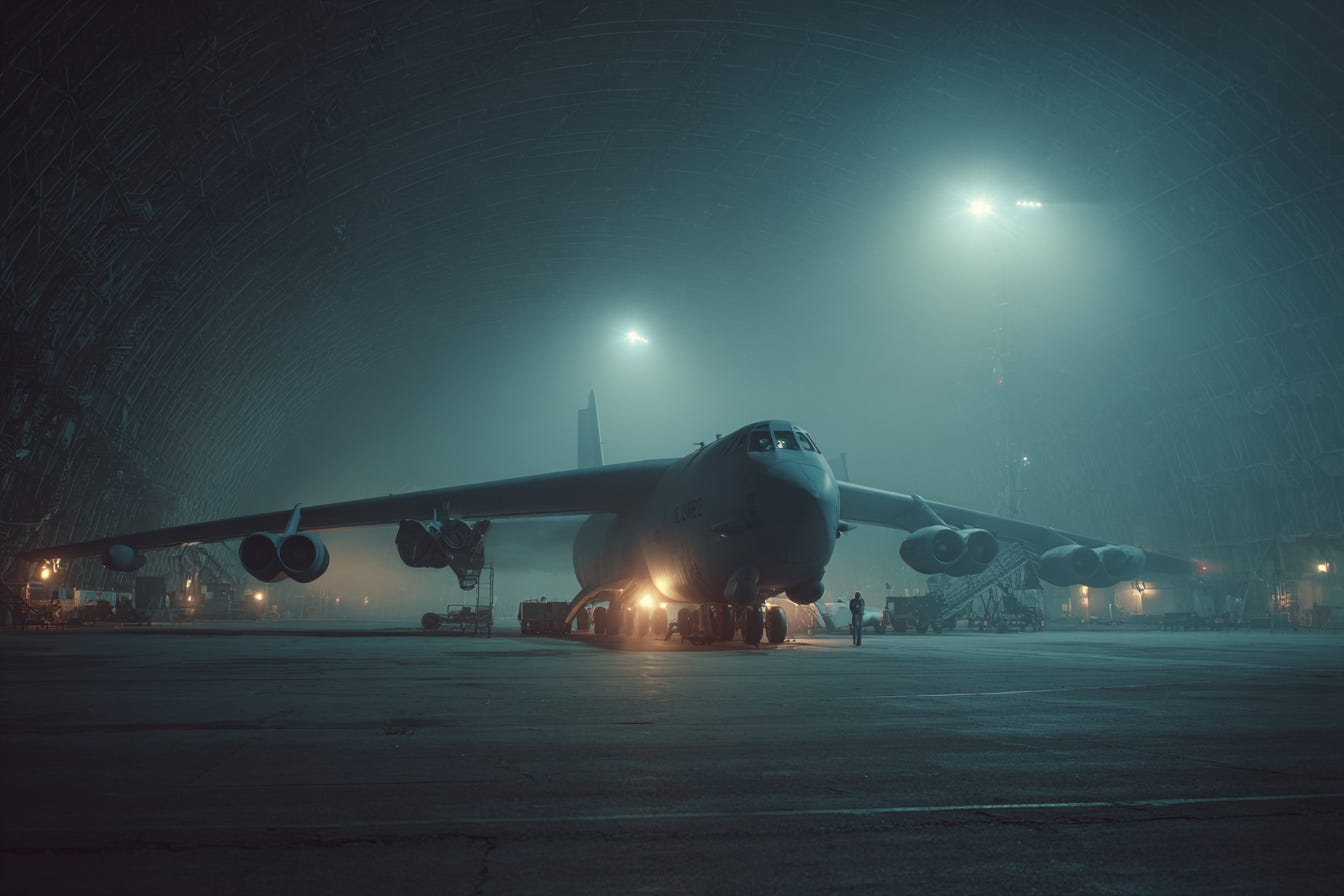
I asked Joshi how long Patel had been planning this.
Joshi shook his head. “That’s the thing. I don’t think he planned it, not originally. The aircraft capability was already there because of the defense contracts. The Indian government had been funding high-altitude flight programs for years. Some of that work, I later learned, included feasibility studies for stratospheric intervention. Not as a deployment plan. As a strategic option. The way you study nuclear capability without deciding to build the bomb. When Raj got his diagnosis, all the pieces were already on the table. He just decided to assemble them.”
The conversation between Patel and Joshi, as Joshi recounted it, centered on a childhood memory. Both men had grown up in western India. Both remembered trying to sleep through afternoon heat that made the air feel solid. Both remembered a time, decades ago, when the heat was survivable.
“He kept pointing at the air conditioner,” Joshi said. “Saying, ‘We have this. Hundreds of millions of people don’t. They’re roasting alive and nobody is doing anything about it.’”
I asked Joshi if he tried to talk Patel out of it.
“I asked him if he was playing God.”
“And what did he say?”
Joshi paused for a long time.
“He just looked at me. And after a while he said, ‘What would you do, Monish? If you had four weeks and all this money and you knew what was coming?’”
VI. Six Weeks
The deployment began on a Tuesday.
The aircraft launched in pairs from two airfields in Tamil Nadu. Each flight climbed to between seventeen and nineteen kilometers before activating the dispersal system, releasing aerosolized sulfur dioxide along pre-programmed flight paths designed to distribute the material across the tropical lower stratosphere. The operation ran continuously for six weeks. Multiple flights per day. There was no announcement, no press conference, no warning.
Fifteen thousand tons of SO₂. A fraction of what a full-scale planetary cooling program would require. But injected at the right altitude, in the right latitude band, it was enough to produce a detectable signal.
The first external indication was a spike in aerosol readings at a monitoring station in Colombo, Sri Lanka. A technician flagged it as an instrument error. When a second station in the Maldives reported similar readings six hours later, the data was escalated to the World Meteorological Organization. By that point, Patel was in a hospital bed, watching the coverage on a muted television.
Within forty-eight hours, the story was global news. Satellite imagery showed a thin layer spreading across the tropics like oil on water. Climate scientists scrambled to model the implications. Governments issued statements that ranged from furious to conspicuously measured. On social media, the reaction split along predictable lines: outrage in the Global North, cautious approval in parts of the South.
The deployment was too small to meaningfully cool India. But that was never the point. The point was the proof of concept. The demonstration that a single actor, operating outside any international framework, could alter the composition of the stratosphere and get away with it. That the taboo could be broken.
In India, the response was complicated. Street protests erupted in Delhi and Kolkata, where activists condemned the deployment as reckless. In the south, where the aerosol haze was faintly visible, the mood was different. On social media, Indian nationalists celebrated what they called a “climate moonshot.” A farmer in Andhra Pradesh told a local news crew that it didn’t matter whether temperatures had actually dropped yet. “Someone finally did something,” he said. “That’s more than the UN has done in thirty years.”

It was during this period that Marina received her promotion.
She didn’t tell me this directly. I pieced it together from dates in public records and things she let slip in our later conversations. Sometime between the deployment and the international fallout, Marina was moved from her analyst desk into a senior policy role. The same deputy director who had taken her off the case signed the paperwork.
When I asked her about the timing, she gave me a careful, rehearsed non-answer about “organizational restructuring.” Then she went quiet for a moment and added, almost to herself: “You learn pretty quickly which questions are worth asking and which ones just make your life harder.”
I didn’t press her on what she meant. I didn’t need to.
VII. The Pandora’s Box Problem
Rajesh Patel died eleven days after the deployment ended.
According to Joshi, Patel spent his final days in a state of oscillating certainty. Some hours, he was serene. Convinced he had done the only moral thing available to him. Other hours, he was terrified.
“The last real conversation we had,” Joshi told me, “he grabbed my arm and said, ‘Monish, promise me you’ll make sure no one does this carelessly.’”
Joshi said he promised. Then he asked Patel who, exactly, he was worried about.
“Everyone,” Patel said. “I’m worried about everyone.”
This is the moment where the story stops being about Rajesh Patel.
Because the question was never whether Patel’s deployment would “work” in the sense of cooling India. It didn’t. Fifteen thousand tons is a demonstration, not a solution. The question was never even whether it was morally justified. Reasonable people disagree, and will continue to disagree, possibly forever.
The question - the one that should keep you awake - is: What happens now that someone has proved it can be done?
Stratospheric aerosol injection has a scaling problem that doubles as a governance nightmare. Patel’s fifteen thousand tons was detectable but climatically trivial. To produce meaningful cooling, you’d need roughly a million tons per year. To sustain that cooling, you’d need to keep injecting, year after year, because the sulfur rains out of the stratosphere over twelve to twenty-four months. If you halt the injections without first reducing the underlying greenhouse gas concentrations, the masked warming comes roaring back. Climate scientists call this “termination shock.” It would be like taking your hand off the thermostat and discovering the house is on fire.
Who decides whether to scale up? Who decides to sustain it? Who pays? Who is liable when the monsoon pattern shifts over Bangladesh, or the Sahel dries out, or the ozone layer thins in ways we didn’t model?
There is no international framework for answering any of these questions. The UN Environment Programme has published reports. Academic institutions have convened panels. But there is no treaty, no convention, no governance mechanism of any kind that addresses what happens when one actor (a country, a corporation, or a dying billionaire) decides to alter the composition of the atmosphere.
Patel didn’t cool the planet. He did something worse. He proved the concept, and in doing so, he issued an open invitation to everyone with the means and the motive to try it at scale.
This is Pandora’s box.
The first person to open it always has a reason. The problem is, the box doesn’t close.
VIII. The Second Deployment
I didn’t plan to write this section.
Six weeks after I finished interviewing Joshi in Mumbai, I received a message from a source I’d cultivated during my reporting. An atmospheric scientist at a European research institution who monitors stratospheric aerosol levels.
“You should look at the latest AOD readings from the Arabian Peninsula,” the message said. “Something is happening that isn’t residual from Patel.”
I pulled the data. Aerosol optical depth measurements over the Persian Gulf had ticked upward in a pattern that couldn’t be explained by the slow decay of Patel’s original injection. New sulfur was entering the stratosphere. Continuously. At volumes that dwarfed the Indian demonstration.
Over the following weeks, through a combination of satellite data analysis, shipping records, and conversations with people who asked not to be identified, I confirmed what the atmospheric scientist had suspected: a second deployment was underway. Not from India. From a facility in a Gulf state whose economy is built on fossil fuels and whose leadership has watched with growing alarm as international climate agreements threaten to strand their primary asset.
Their motivation is the mirror image of Patel’s. He wanted to cool the planet because his people were burning. They want to cool the planet because if temperatures stabilize, the political pressure to transition off fossil fuels decreases. Geoengineering, for them, is not a last resort. It’s a business strategy. Keep the sky cool and the oil flowing.
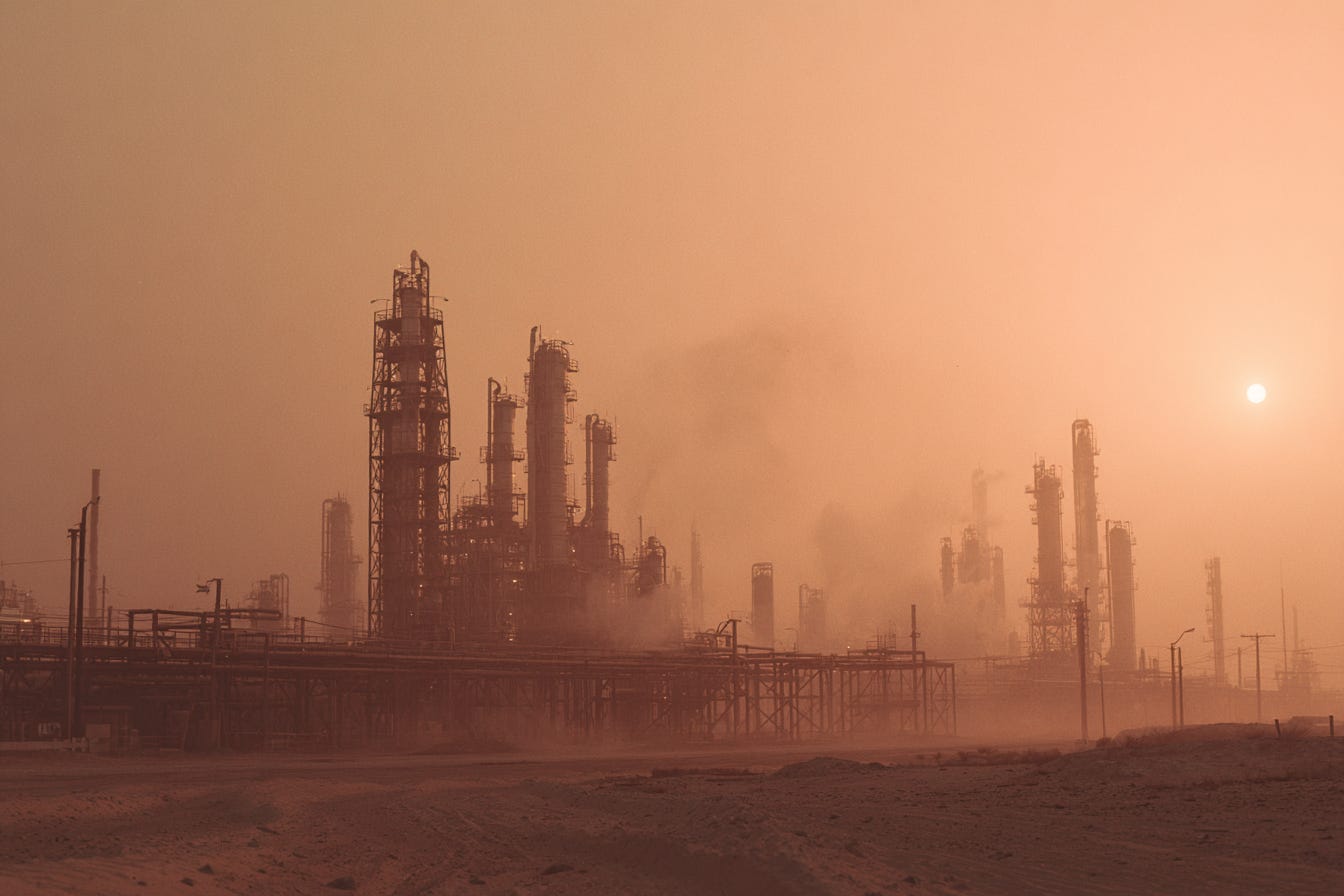
Where Patel’s operation was a demonstration, this one is built for scale. My sources estimate the injection rate at several hundred thousand tons per year and climbing. Enough to produce a measurable regional cooling effect. Enough to change the politics of climate policy worldwide.
I reached out to Marina one more time. I told her what I’d found.
There was a long pause. When she spoke again, her voice had the flat, careful tone of someone choosing every word for a transcript.
“I’m not in a position to comment on that.”
I asked if she was aware of any monitoring efforts related to the Arabian Peninsula readings.
“I’d encourage you to direct those questions to the appropriate interagency channels.”
That was all I needed to hear. Not because of what she said. Because of what she didn’t say. The Marina I’d met in that diner six months earlier would have cursed, or laughed, or asked me where I got my data. This Marina had learned the language of the institution. She answered like someone who’d been briefed on how to answer.
IX. White Sky
I went back to Chennai before filing this story.
I wanted to see the sky one more time, now that I knew what I knew. That the white veil above me was no longer one man’s desperate act but the opening chapter of a geopolitical contest with no rules, no referee, and no endgame.
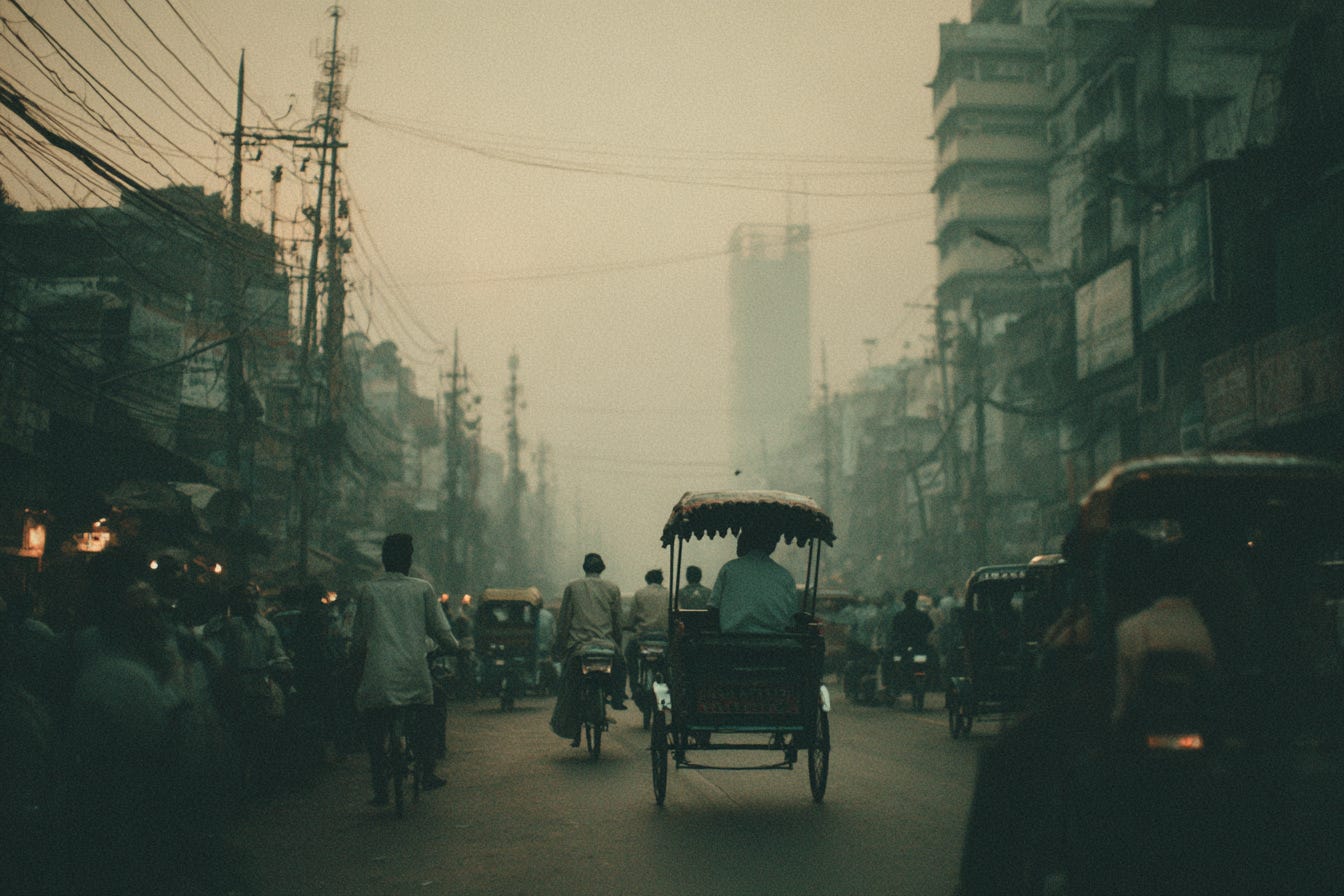
I took a rickshaw through the old city. The driver, a man in his fifties, glanced up through the windshield at the flat white dome above us.
“Beautiful, isn’t it?” he said. “We call it the Indian Milky Way. You can see it even during the day now.”
Rajesh Patel opened the box. And now the rest of us have to live inside it.
🙏 Thanks Ben for the initial idea and brainstorming. A big shoutout to Liam, Don, Kip, Nick, Sara, Megan, Berkay, and many others who have helped me birth this monster into existence.

If you enjoyed this essay, please consider forwarding it to a friend who would enjoy reading a wild story 🌳
If you have feedback/ideas/critique/etc., please get in touch.
As always, stay healthy, stay happy ✌️ The world is a messy place.
Art
This is so good to the extent that when I jumped the intro paragraph to the actual story, not knowing this is a Cli-Fi, I was like shit, when did this happen, and I got worried for real, then I thought I need to double check how true the events are before sharing it, only then I figured it out. you should write more of these