

The Loudest Silence on Earth
Why We Tend to Miss the Most Important Information Around Us

👋 Hello to 3,418 climate buddies 🌳
Delphi Zero explores the interplay of climate, energy, and security 🌳🔋🛡️
📧 If you are opening this essay in your email inbox, I recommend clicking on the title of this piece to enjoy the full-length version in the browser.
Hi friends,
Today, I’ll write the first of a ten-part series called Sound of Antarctica: What the Quietest Continent Teaches Us About Paying Attention.
This topic has been on my mind for more than a year. Finally, I found the words to explain why Antarctica had such a lasting impact on me (and why the core motif of this series is applicable to all of us).
Thanks for gifting me your attention 🙏 Let’s go.
The Loudest Silence on Earth
By Art Lapinsch
We crossed the Drake Passage in two days.
48 hours of open ocean, no internet, no signal, nothing but water and a ship full of strangers slowly becoming friends. By the time we spotted the first iceberg through the fog, I thought I’d already made the transition. Civilization behind me. Antarctica ahead. Done.
But I was wrong. The ship is a sealed environment. You don’t notice it because everything feels so different from normal life - no emails, no notifications, no deadlines - that you mistake the absence of your routine for the presence of something new. But the ship has its own noise. The engine hums through the hull at all hours. Air vents push recycled air into the corridors. Passangers and crew members do whatever it is they do.
It’s relatively quiet but it’s still a human-made soundscape.
The actual arrival happened on the water.
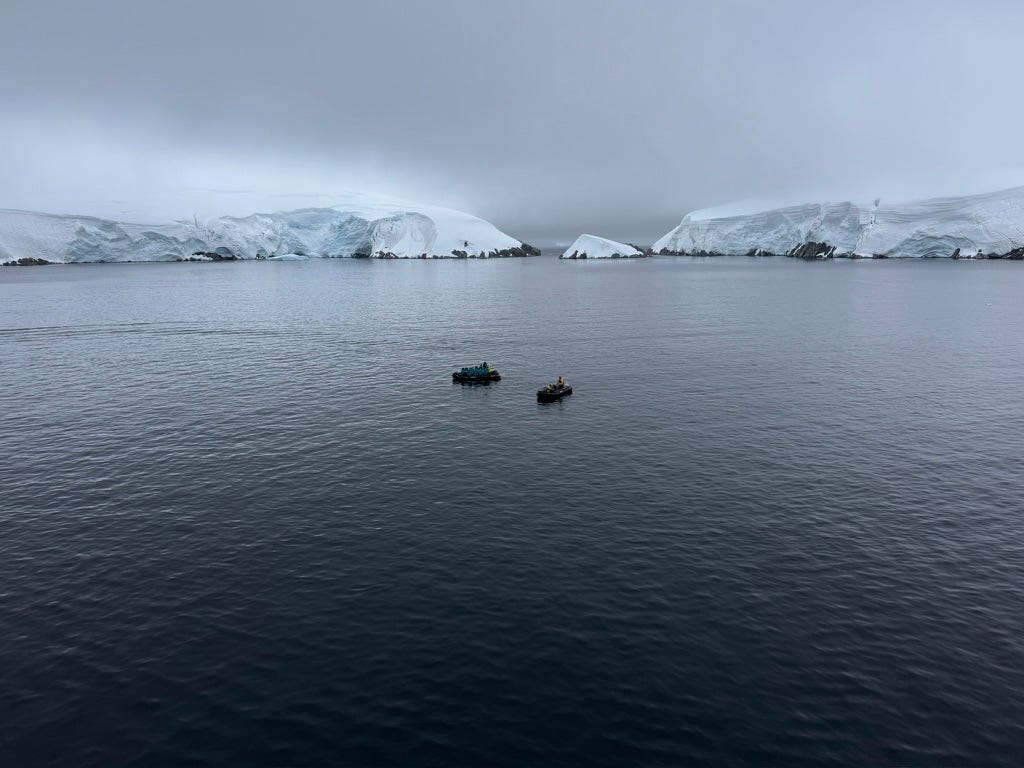
We’d reached the Melchior Islands ahead of schedule, and the captain surprised everyone with an unplanned zodiac boat excursion. The energy on board was through the roof. People scrambled to their rooms, layered up, clipped on life jackets, and shuffled down to the embarkation deck to put on their rubber boots.
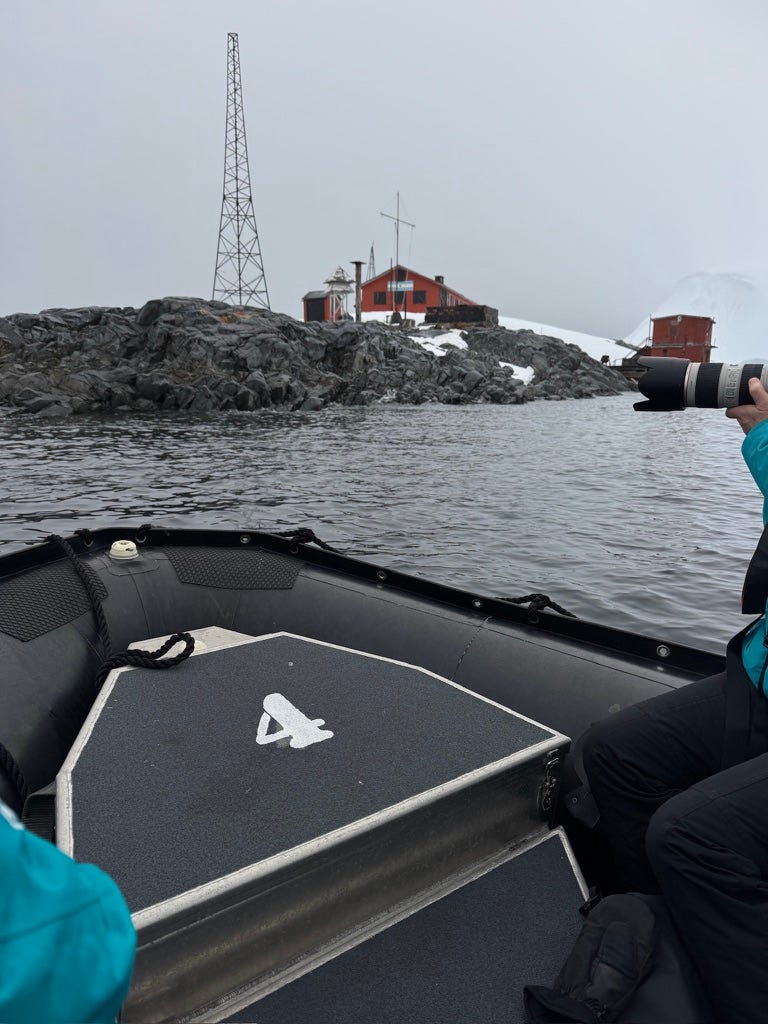
I ended up on Zodiac 4. Maybe eight or ten of us, shoulder to shoulder on that black rubber grip mat, knees almost touching. The guide stood at the back, radio strapped to his chest, one hand on the outboard motor. We launched off the ship and into the bay.
For a few minutes, everything was movement and noise. The engine buzzing. Cold air against exposed skin. Water slapping against the inflatable hull. People pointing at everything - Melchior Base research station with its red paint, a fur seal sitting upright on a boulder like it owned the place, glacier faces glowing pale blue against a hazy grey sky. Everyone had a camera out. Everyone was looking.
Then the guide killed the engine.
Two seconds. Maybe three. The mechanical engine sound drops away.
Five seconds. The zodiac’s forward momentum starts to fade. The slap of water against rubber softens.
Ten seconds. The wake dissolves. The boat goes still.
And then there’s just… nothing.
Not silence exactly. But nothing that we made. A faint slapping of water against ice somewhere. The occasional plop of a penguin surfacing behind us. A seal shifting its weight on a nearby rock. And behind all of it, something heavier - not a sound but a weight, as if the air itself was holding something it hadn’t released yet.
Tears started rolling while I was smiling. I know I wasn’t the only one who’d gone completely still. I didn’t understand what was happening to me at the time, and it took almost a year to piece it together.
The ship had flushed my inbox. The Drake had flushed my routine. But that moment on the zodiac - engine off, wake gone, nothing between me and the ice - flushed something deeper. Something I didn’t know needed flushing.
It wasn’t that the silence gave me something new. It removed what had been in the way.
I just didn’t have the language for it yet.
I hadn’t learned to listen yet.
Why Antarctica Is So Quiet
Here’s the thing about Antarctica: it’s not just a quiet place. It may be the quietest natural environment on Earth.
Explorer Erling Kagge, who walked solo to the South Pole with a broken radio, wrote that Antarctica was the quietest place he’d ever been. No life. No signal. Nothing.
And physics explains why.
Snow and ice are extraordinarily good at absorbing sound. Think of how the world goes muffled after a heavy snowfall - that’s a couple of centimeters doing the work. Now imagine an ice cap that averages two kilometers thick. Antarctica’s surface is, in effect, a continent-sized acoustic dampener. No trees to rustle. No insects to hum. No roads, no cities, no infrastructure. On a calm day in the dry valleys, the ambient noise approaches the threshold of human hearing - roughly 0 decibels.
To put that in context: Microsoft spent big money to build an anechoic chamber - six layers of concrete and steel, vibration-damping springs, fiberglass wedges on every surface - and achieved -20.3 dB. It holds the Guinness World Record for the quietest room on Earth. Antarctica’s dry valleys, on a windless day, get close to those conditions naturally. No engineering required. Just ice, snow, and the absence of everything we’re used to.
If you’ve read my piece on Climate Tech’s Resonant Frequencies, you’ll remember the Shannon-Weaver model — the “mother of all models” for how communication works. Sender encodes a message, transmits it as a signal through a channel, receiver decodes it on the other end. Noise degrades the signal along the way.

Antarctica, acoustically, is the Shannon-Weaver model stripped to nothing.
There’s barely any sender - no fauna density, no human activity, no mechanical noise generating signals. The channel itself - snow and ice - is hyper-absorbent, swallowing whatever sound does get produced before it can travel. And the noise floor is practically zero. It’s a communication system with nothing to transmit, a medium that eats its own signal, and no interference because there’s nothing left to interfere with.
Your ears, which evolved to decode signals from a world full of senders, are suddenly tuned to an empty channel. That’s what creates the feeling. It’s not just peaceful. It’s disorienting.
Or so your ears would have you believe.
Because here’s where it gets strange. Silence doesn’t just feel peaceful. It does something to you physically.
Researchers at the Alfred Wegener Institute studied expedition crews who spent 14 months at Neumayer Station in Antarctica. After the stint, brain scans revealed measurable shrinkage in the hippocampus - the region responsible for spatial navigation, learning, and emotional processing. The sensory deprivation of the polar environment was literally reshaping their neural architecture. Similar patterns show up in studies of solitary confinement.
The human brain does not handle the absence of stimulation well.
We are, it turns out, spectacularly bad at being still.
Which is what makes the Antarctic experience so disorienting. You arrive at the quietest place you’ve ever been, and something inside you short-circuits. Your senses, so accustomed to filtering signal from noise, suddenly have nothing to filter. And in that vacuum, something else shows up. Something that was always there, drowned out by the hum of the ship, the ping of the inbox, the chatter of daily life.
The silence doesn’t fill you. It empties you. And what’s left is what was always underneath.
The Silence Paradox
A few days into the trip, we hiked up a hill during one of our land excursions and stood looking out across a bay. Icebergs scattered across the water like chunks of marble someone had forgotten to clean up.
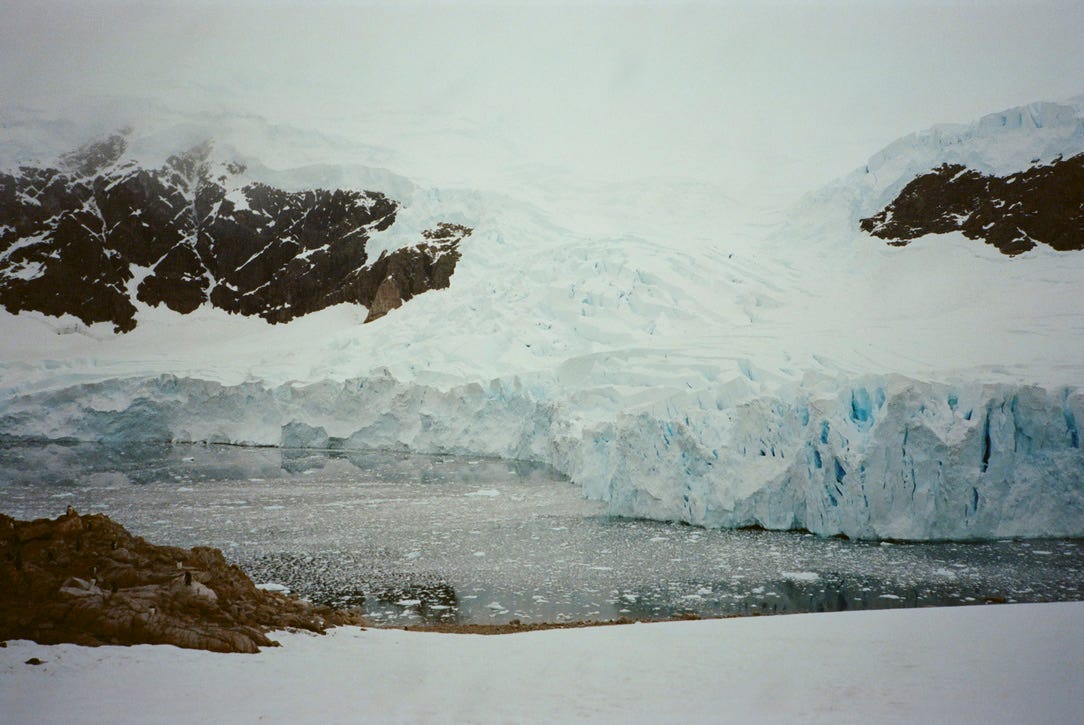
At some point, I noticed movement on one of the larger icebergs in the distance. A section of it - massive, probably the size of a multi-story building - detached from the main body. And it was falling. Slooooowly. So slowly that it looked almost unnatural, like watching a skyscraper collapse in slow motion.
It took a long time to hit the water. When it did, we could see the impact - a massive eruption of white spray shooting up from the surface, waves radiating outward. But we couldn’t hear anything. Just the visual, playing out in what felt like total silence.
And then, a few seconds later, the sound arrived. A deep, rolling crack followed by a thunderous boom that echoed across the bay and hit us in the chest.
The delay was maybe three or four seconds. Which means the iceberg was roughly a kilometer away. But it felt like an eternity - watching destruction happen in silence, then being hit by the sound after the fact. I’ve never experienced anything like it. In daily life, sight and sound arrive together. You don’t think about the speed of sound because you never need to. But at that scale, with that distance, the gap between seeing and hearing becomes visceral. Your brain knows something is wrong. The timeline doesn’t match.
That moment taught me something I didn’t fully grasp until much later: Antarctica only appears silent because human senses are the wrong instrument.
Because beneath the surface - literally, below the ice and below the water - Antarctica is one of the loudest places on Earth.
The Southern Ocean is among the most acoustically active environments on the planet. Icebergs collide at source levels exceeding 190 decibels - 30 times louder than a jet engine at close range, detectable from thousands of kilometers away. Blue whales produce vocalizations between 18 and 26 Hz that travel across entire ocean basins. The Ross Ice Shelf - a slab of ice roughly the size of France - vibrates continuously, producing a low hum that was only discovered in 2018 when scientists happened to bury seismometers in the right place.
None of this is audible to a person standing on the surface. It’s below our frequency range, or underwater, or propagating through ice at wavelengths we can’t perceive. The continent is screaming. We just can’t hear it.
The gap between what the surface feels like and what’s actually happening underneath is, in a word, enormous. And it’s not unique to Antarctica.
The Bigger Story
I’ve spent the past few years writing about climate, energy, and the stories we tell about both. If there’s one thread running through all of it, it’s this: the most important things happening on this planet are often happening below the threshold of casual observation.
An ice shelf hums a song for millennia before a seismometer picks it up. A glacier cracks apart in a pattern that standard monitoring networks were never designed to detect. A whale population shifts its migration route in response to ocean temperature changes that satellites can’t see from the surface.
These aren’t metaphors. These are real phenomena - real signals - that existed long before anyone built the instruments to hear them. The signal was always there. What was missing was the right tool, pointed in the right direction, by someone who had a guess what to listen for.
Antarctica taught me that this applies far beyond ice and water. It applies to how we consume information, how we evaluate technology, how we build policy, and - broadly speaking - how we pay attention to the things that matter.
We mistake the absence of signal for the absence of reality. We assume that if we can’t perceive it, it isn’t happening. And then we’re surprised when the iceberg calves, the shelf collapses, the glacier retreats.
The attention we pay determines the truths we can see.
And sometimes, paying that attention means deploying the right instrument.
What’s Coming
This is the first of a ten-part series called Sound of Antarctica: What the Quietest Continent Teaches Us About Paying Attention.
Over the next nine pieces, I’m going to highlight how different people listen to this unique continent. Not metaphorically - literally. We’re going to explore ice shelves that sing, whale calls that cross ocean basins, glaciers that produce earthquakes invisible to standard monitoring, and a Cold War surveillance network that accidentally became one of our most powerful climate tools.
Every piece will follow the same thread: something important is happening. We needed a specific instrument to hear it. And what we heard changes how we understand the world.
Here’s the plan. New pieces drop every two weeks, for the next five months:
The Loudest Silence on Earth - this one
The Singing Ice Shelf - A Texas-sized slab of ice plays a song only seismometers can hear
Iceberg Songs and Icequakes - When Antarctica screams, Australia picks up the phone
The Ocean’s Secret Highway - How a WWII survival trick became climate science’s best tool
The Z-Call - Tracking the world’s largest animal by its lowest note
The Bio-Duck Mystery - Antarctica’s strangest sound and the 50-year quest to name it
The Doomsday Frequency - Listening to the Thwaites Glacier crack apart
The Last Quiet Ocean - Noise pollution arrives at the bottom of the world
Taking the Ocean’s Temperature with Sound - The most elegant climate tool you’ve never heard of
Composing at the End of the World - What happens when climate data becomes music
I’m committing to this publicly because accountability matters. And because I think this story - the story of how sound reveals what eyes can’t see - deserves to be told properly, piece by piece, with the depth it requires.
If any of that sounds interesting, subscribe.
I’ll see you in two weeks 🌊
If you’re new here: Delphi Zero explores the interplay of climate, energy, and security. Welcome aboard 🌳
Looking forward to the upcoming pieces :D
Also, do check out Ends of the Earth by Neil Shubin. I loved reading it. So many surreal revelations! Having already been to Antarctica enhances the reading experience ;)
I loved reading this!